Chongqing
China's Mountain City — where the Yangtze meets the jungle.
China's Mountain City — where the Yangtze meets the jungle.
Chongqing is the city that makes other Chinese cities feel orderly. Built where the Yangtze and Jialing rivers meet, on terrain so steep that buildings stack 20 stories above the streets below, the city operates in eight dimensions at once — hence the nickname "8D city." Your map app will regularly announce "you have arrived" while you are standing on the wrong side of a 12-lane highway. This is not a failing of your phone. This is just Chongqing.
TL;DR — Quick Guide to Chongqing:
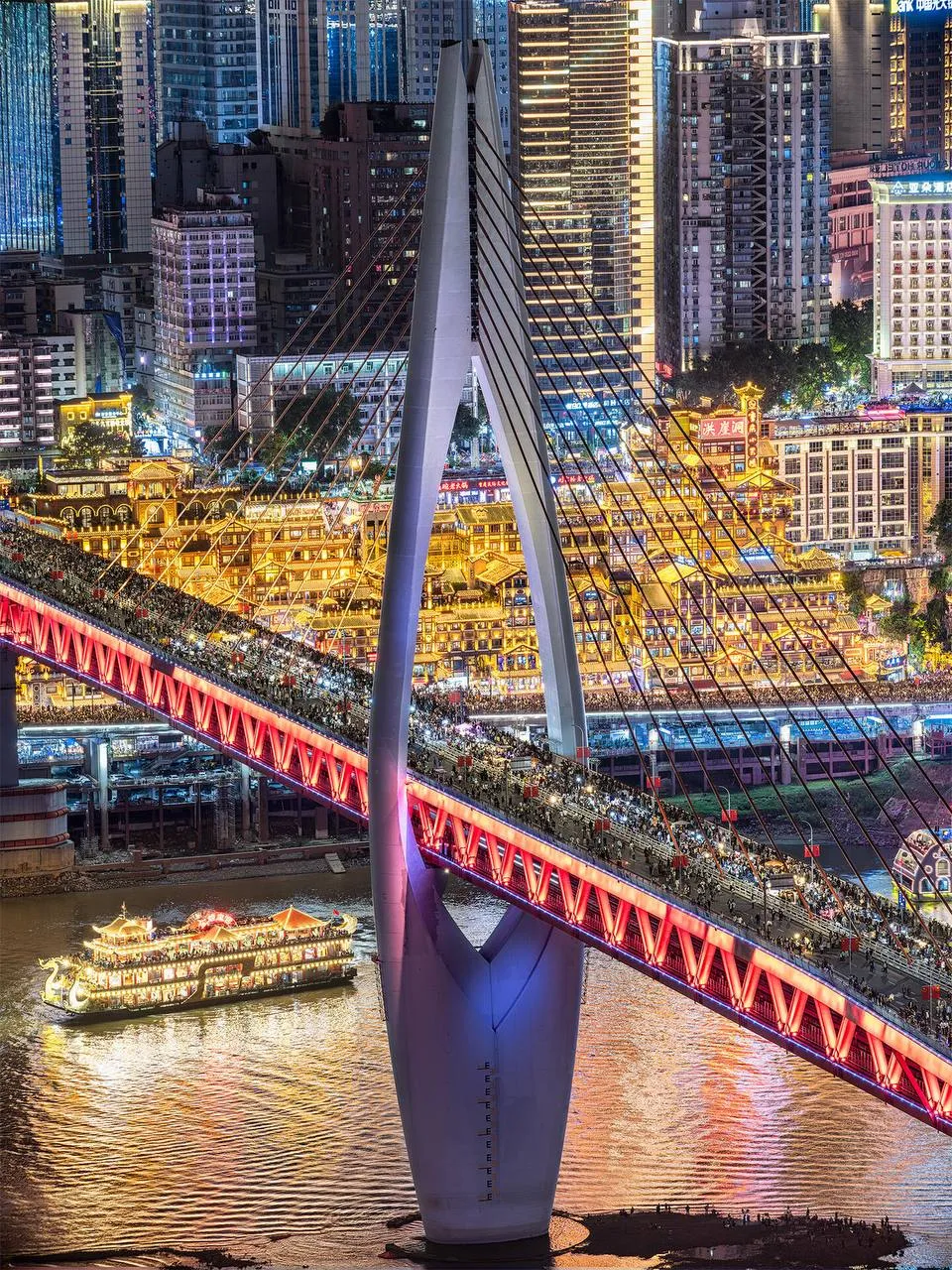
Twenty million people live here, and the energy matches the scale. The food is extraordinary — Chongqing is the undisputed birthplace of mao la huo guo (numbing-spicy hot pot), and the version served at tiny restaurants in the old city, where the broth is a deep red and the meat comes in paper-thin sheets, is a revelation. At night, when the city's thousands of towers light up the river valleys, Chongqing looks like a science fiction film set.
A 11-story riverside complex built into a cliff face, with traditional stilted architecture and thousands of red lanterns at night. The real magic is at 8pm when the floodlights hit — the building appears to float above the river. Take the elevator down from the top floor directly to the riverbank. The surrounding night market is touristy but the architecture is genuine.
The cable car crosses the confluence of the Yangtze and Jialing rivers in a fully enclosed cabin, giving you a straight-down aerial view of the river traffic below — cargo ships, cruise boats, and the city skyline rising behind them. The south station is near Hongyadong; the north station is near Eling Park. A one-way ride takes about 6 minutes and is one of the cheapest thrill rides in China at roughly $4.
A preserved Qing Dynasty pottery and tea village on the edge of Chongqing, reached by Line 1 metro in about 30 minutes from the city center. The main street is 800 meters of slate cobblestones, flanked by craft shops selling porcelain, calligraphy, and local tea. Come on a weekday to avoid the weekend crowds that pack the narrow alleys shoulder to shoulder.
March to May and September to November are the best windows — temperatures between 15-25°C, manageable humidity, and clear river views. Summer (June to August) is brutally hot (40°C+) and humid, and the city becomes a steamer of slow-moving tourists. Winter (December to February) is grey and damp but the city is less crowded and the night views are at their most atmospheric. Spring brings occasional fog that can obscure the skyline for days.
Chongqing Jiangbei International Airport (CKG) is 30km north of the city center, connected by Metro Line 3 and an airport express bus. High-speed trains arrive at Chongqing North Railway Station from Chengdu (2 hours), Xi'an (5.5 hours), and Beijing (12 hours via high-speed rail). Chongqing is also the starting point for Yangtze River cruise ships heading east toward the Three Gorges and Wuhan.
2–4 days. The city is large and its 8D street layout takes time to understand. A minimum of 2 full days lets you cover the highlights.
Built on cliffs where the Yangtze and Jialing rivers meet, Chongqing's terrain creates a layered urban maze — roads pass over each other, buildings connect via unusual shortcuts, and orientation shifts constantly.
Generally very safe. Violent crime is rare. Common-sense precautions apply. Note that the many stairs and slopes can be physically demanding — wear comfortable shoes.
Expect wok-fresh ingredient combinations and profoundly spicy broths. The city invented many iconic styles — including 鸳鸯锅 (yuanyang pot, half spicy half mild). Allow your taste buds to adjust for the first day or two.
Autumn and winter give the best views — the fog and night lights make the city's hills and river bridges look like a cyberpunk film. Summer is hot and humid.
Let us craft your perfect Chongqing itinerary — tailored to your interests and travel style.
Start Planning →