Guilin
Karst Wonderland — Li River Cruises & Mountain Scenery
Karst Wonderland — Li River Cruises & Mountain Scenery
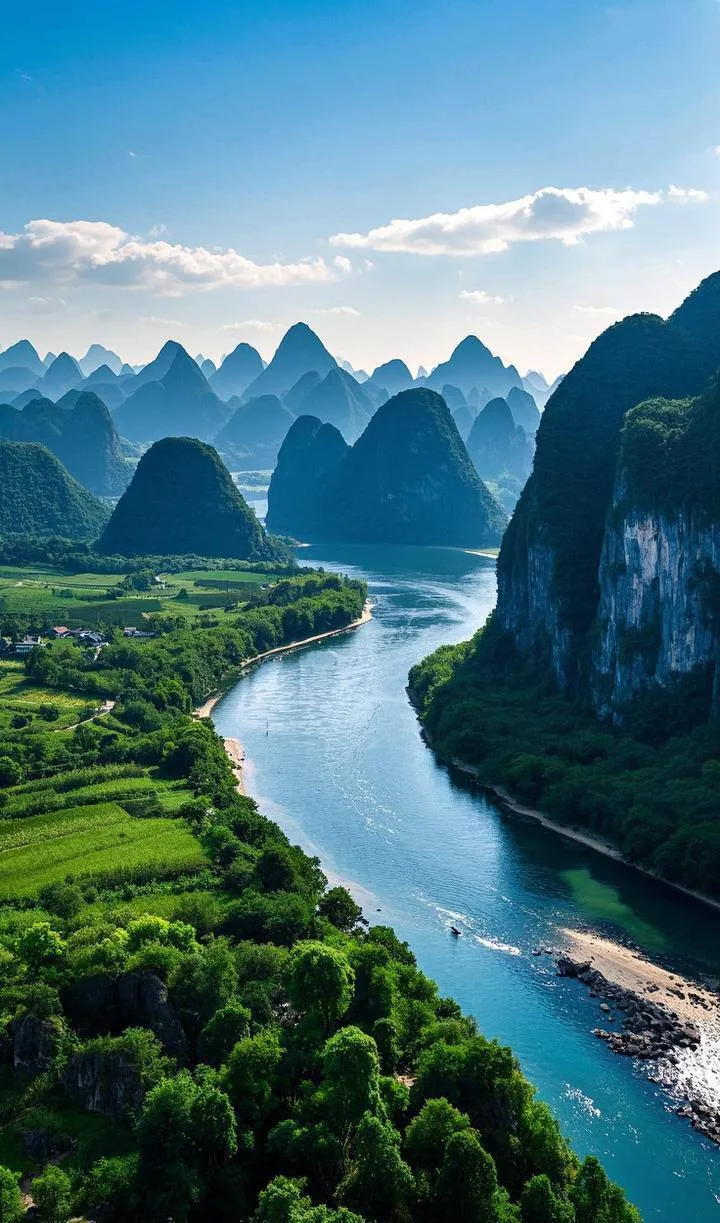
Guilin is China most photographed landscape — the karst peaks that rise abruptly from the flat valley floor, draped in bamboo and disappearing into morning mist, have been painted, poetry, and photographed for a thousand years. No image fully prepares you for seeing them in person. The peaks are not gentle hills — they are sheer limestone formations that look as if they were pushed up from below and then weathered into these improbable, theatrical shapes. The Li River between Guilin and Yangshuo is the definitive version of this landscape, best seen from a slow boat cruise or from the seat of a bamboo raft on the Yulong River.
TL;DR — Quick Guide to Guilin:
The city itself is modest — this is not a destination for urban sightseeing. People come for the surrounding countryside, which is best experienced in Yangshuo, a small town 65km south of Guilin city where the river bends, the peaks close in, and the karst landscape is most dramatic. Yangshuo has developed a small but charming expat and tourism community over the past two decades without losing its essential character.
The four-hour downstream cruise from Guilin to Yangshuo is one of the classic journeys in China — the entire 65km route passes through the most spectacular karst landscape, with the best views coming in the middle two hours. Book a government cruise ship (not a private boat) for the most reliable and scenic experience. The cruise is best in the morning — by afternoon the light is flatter and the mist has burned off. Bring a camera and a thermos of tea.
The Yulong River, south of Yangshuo town, is a gentler alternative to the main Li River — narrow, clear, and flanked by bamboo groves and peaks. Bamboo rafts for two depart every few hundred meters and the full river run takes 2-3 hours, stopping at old stone bridges and swimming spots along the way. The experience is quiet and immersive — the only sound is the bamboo pole hitting the water and the occasional cormorant. Renting a scooter and cycling the country roads around Yangshuo is equally recommended.
A 240-meter-long cave 7km northwest of Guilin city, filled with formations that are dramatically lit in different colors — pink, purple, blue. The stalactites have names based on their shapes: Sword Mountain, Crystal Palace, Virgin Snow. The cave has been a tourist attraction since the Tang Dynasty, though the current lighting system dates from the 1990s. Allow 1 hour. The entrance is walking distance from the bus stop; the cave itself is flat and accessible.
April to October is the best window — the river is full, the bamboo is green, and the water is warm enough for swimming in Yangshuo. Summer (July to August) is peak season but the river can flood after summer rains, which occasionally disrupts boat schedules. Autumn (September to November) is quieter with cooler temperatures and less rain. Winter (December to March) is the off-season — the river is lower, some bamboo rafts are not running, and mornings can be cold and foggy, but the light on the peaks in early morning is extraordinary. Spring (March to April) brings the "sea of mist" — a phenomenon where the valley fills with thick mist and the peaks appear as islands in a white sea.
Guilin Liangjiang International Airport (KWL) is 30km southwest of the city center, with domestic flights and some regional international routes. High-speed trains arrive at Guilin Railway Station and Guilin North Railway Station from Guangzhou (2.5 hours), Shenzhen (3 hours), and Beijing (10 hours). The train journey from Guangzhou is scenic — the line passes through some impressive karst terrain before arriving at the Guilin basin. The bus from Guilin to Yangshuo takes 90 minutes and departs every 20 minutes from Guilin Qintan Bus Station.
3–4 days to properly explore the karst landscape. The Li River cruise (Guilin to Yangshuo, 4–5 hours) is the highlight, and Yangshuo deserves at least a full day of cycling and river activities.
The 83km cruise passes between towering karst peaks — the landscape that appears on China's 20-yuan banknote. It's a relaxed journey with stopovers at fishing villages. Spring and autumn give the best light.
For most visitors, yes. Yangshuo is where the karst landscape is most dramatic and accessible — cycling, bamboo rafting, and cormorant fishing all happen here. Guilin city is the transport hub.
April to October is the scenic peak. Spring brings misty mountains; summer is warm and green; autumn has golden rice fields. The river is lowest in winter but karst peaks are still beautiful.
No — Guilin and Yangshuo are very budget-friendly. Hostels from $15/night, meals from $3–5, bicycle rental from $3/day. The main costs are the Li River cruise and internal transport.
Let us craft your perfect Guilin itinerary — tailored to your interests and travel style.
Start Planning →